Licensed guides in Morocco come in two kinds, and the difference matters more than most travellers expect. The guide who walks you through the Fes medina and the guide who leads you over a High Atlas pass hold separate licences, granted under the same law and checked by the same Ministry. Book the wrong one and you could end up with someone who knows every carved doorway in the old city but was never licensed to take a group into the mountains.
Quick answer
Morocco licenses two types of tourist guide under Law 05-12. A city and circuits guide (GVCT) works in medinas, monuments, museums and on touring routes. A natural areas guide (GEN) leads trips in mountains, deserts and villages. Each licence covers its own ground only, every guide must carry a Ministry badge, and you can check names on the Ministry’s official list.
Two licences, one law: what Law 05-12 says
Guiding is a regulated profession in Morocco. Law 05-12 on the tourist guide profession, promulgated in September 2012 and amended four times since, says nobody may work as a tourist guide without an approval issued by the authorities (Article 5). Its first article defines the guide as the person who accompanies tourists for pay and looks after their safety and peace of mind, as well as their information.
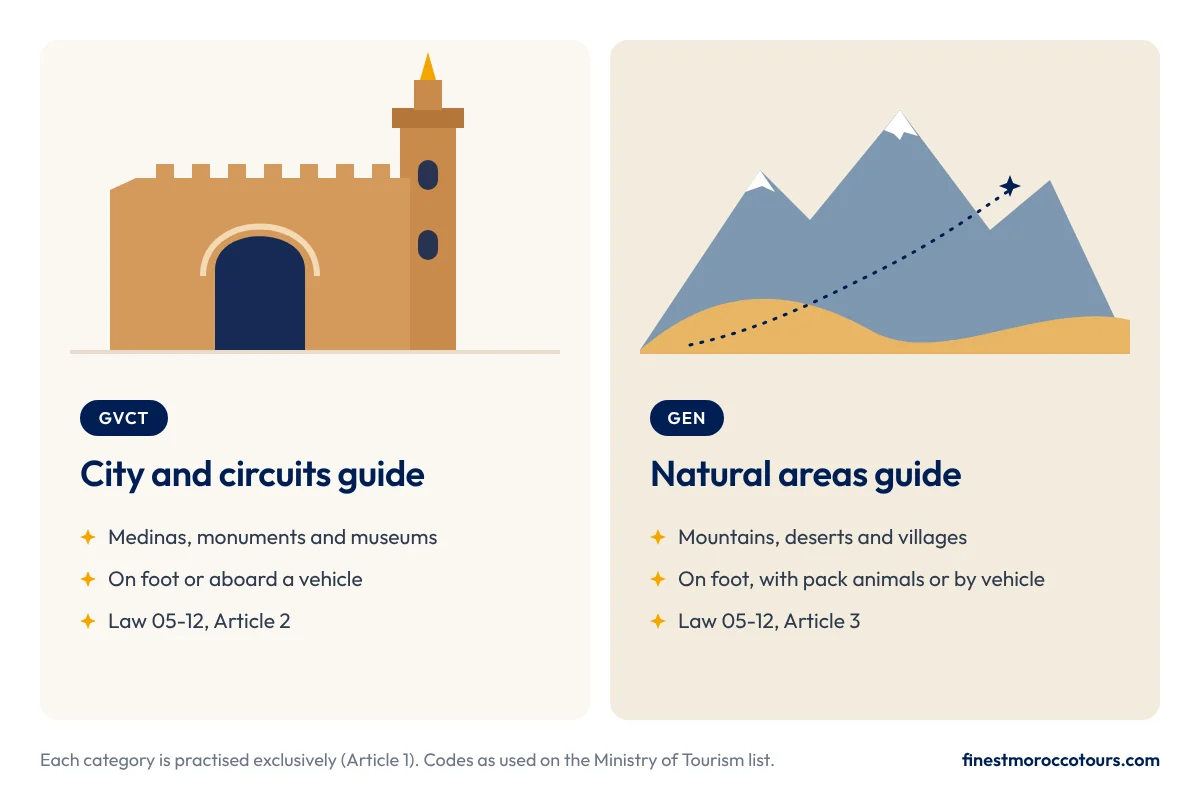
That same article splits the profession into two categories and states that each one is practised exclusively. A guide holds one licence or the other, and the licence decides where they can work. The Ministry of Tourism’s page on tourist guides summarises both, and the table below sets them side by side.
| Licence | GVCTCity and circuits guide | GENNatural areas guide |
|---|---|---|
| Legal basis | Law 05-12, Article 2 | Law 05-12, Article 3 |
| Where they work | Streets, tourist sites, monuments, museums, cultural venues, hotels and public places | Natural sites such as mountains, deserts and villages |
| How they travel with you | On foot or aboard a transport vehicle | On foot, with pack animals or in a suitable vehicle, on paths, tracks and practicable roads |
| What they explain | History, architecture, culture, society and the economy of the places you visit | The natural, historical, cultural and social side of the areas you cross |
| Typical trips | Fes or Marrakech medina walks, palaces and madrasas, Volubilis, Rabat’s monuments | Toubkal and Mgoun treks, Jbel Saghro, walks in Erg Chebbi or Erg Chigaga |
| Outside the licence | Leading treks and desert walks, which belong to the other category | Climbing, mountaineering or ski techniques, and city guiding |
| Where they can work | Anywhere in Morocco, within their field (Article 4) | Anywhere in Morocco, within their field (Article 4) |
A natural areas guide can move across to the city category, but not overnight. Law 67-21, passed in 2021, asks for ten years of experience, a Ministry exam and a training course of up to three months before the switch, with an exception for guides whose health no longer allows mountain or desert work.
Why does a mountain or desert guide need a different licence?
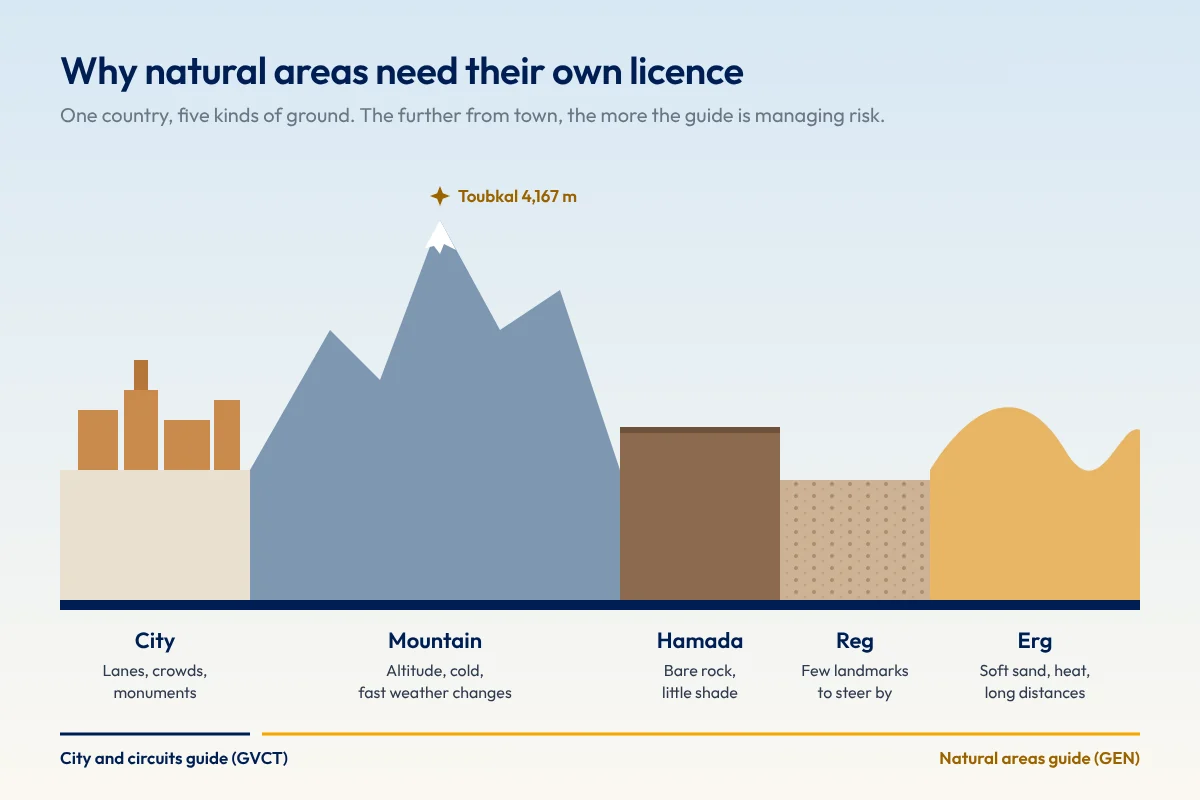
Because the risk changes with the ground. In a medina the hazards are crowds, scooters and a maze of lanes, and help is never far away. On a trek or a desert walk the guide is often hours from a road and answers for pace, water, weather and the way back, which is exactly what the law means when it puts the tourists’ safety in the definition of the job.
In the High Atlas, Toubkal reaches 4,167 metres. Weather can turn within an hour, snow sits on the high passes into spring, and a twisted ankle on a scree slope becomes an evacuation problem rather than a taxi ride. Setting a pace that suits the altitude, deciding when to turn back and organising mules and muleteers for the loads is the work a natural areas guide is licensed for.
The desert is less uniform than it looks from a camp terrace. Southern Morocco mixes sand seas, gravel plains and bare rock plateaus, and each one changes how a group walks, where it finds shade and how it keeps its bearings. If you want to picture the ground before you go, this guide to the difference between erg, reg and hamada makes plain why a desert day is planned around far more than the dunes.
Training follows the same logic. Candidates for the natural areas licence need a specialised technician diploma in the natural areas guide track from the state hotel and tourism institutes, as Aujourd’hui le Maroc reported when the rules took effect. Mountain guiding also has a long local school: the Centre de Formation aux Métiers de Montagne in Tabant, in the Aït Bouguemez valley, had trained more than two hundred Moroccan mountain leaders by the mid-1990s.
The licence has a clear edge too. Article 3 covers trips on paths, tracks and practicable routes without climbing, mountaineering or ski techniques. A winter ascent with crampons and ice axe, or a rock route, is a different job, so ask what extra mountaineering qualification the guide holds before you book one.
How many licensed guides are there in Morocco?
About 4,600. Hassan El Janah, president of the National Federation of Tourist Guides, gave SNRT News a total of 4,627 licensed guides: 3,211 city and circuits guides and 1,416 natural areas guides. Roughly two in three guides you meet will hold the city licence.
Licensed guides by category
- City and circuits (GVCT) 3,211
- Natural areas (GEN) 1,416
New approvals in the two professional exams
Sources: National Federation of Tourist Guides via SNRT News; Ministry of Tourism figures reported by Medias24 (2018 exam) and Le360 (2023 exam).
The two exams that brought experienced but unqualified guides into the system show where demand is moving. In the 2018 round, natural areas guides were 203 of 1,108 new approvals. In 2023 they were 459 of 1,299, close to double the share.
How to check that a guide is licensed
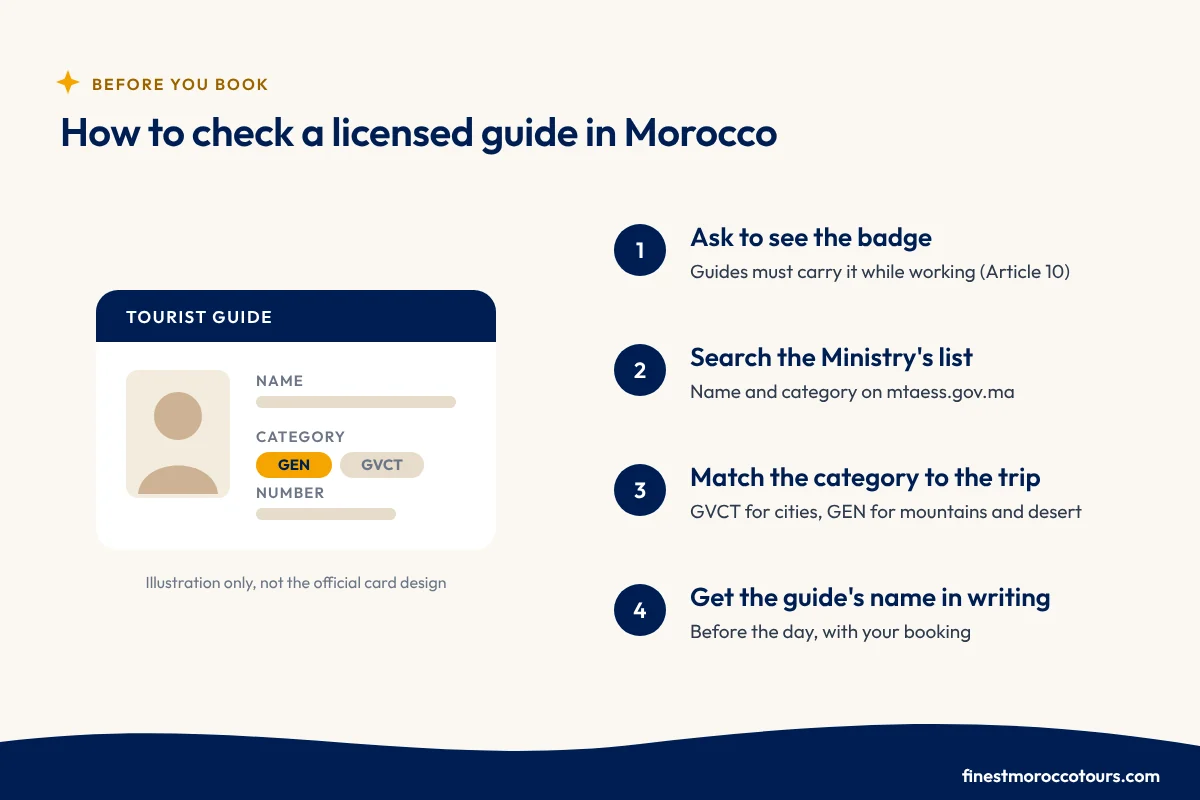
- Ask to see the badge. The Ministry issues a badge with every approval, and Article 10 obliges the guide to carry it while working and show it to sworn inspectors on request. A professional will show it to you without fuss.
- Search the Ministry’s list. The official guides page lists every licensed guide with a category code, GVCT or GEN, and a search by name.
- Match the category to the plan. GVCT for medinas, palaces and museums. GEN for treks, desert walks and village hikes.
- Get the name before the day. Ask for your guide’s full name and category in writing. A professional operator will give you both without hesitation.
The law backs these checks. Passing yourself off as a tourist guide is punished under Article 381 of the Penal Code (Article 21), and a guide who lends, rents or hands over their badge faces six months to a year in prison, a fine of 10,000 to 20,000 dirhams, or both (Article 22). The unlicensed “guides” most visitors meet are the ones who attach themselves to you at a medina gate. A polite no and walking on is all it takes.
Do you need a guide for Toubkal?
Yes. Since early 2019, hikers on the Imlil to Toubkal route have had to walk with a local guide, and police at checkpoints along the trail record passports and guide details, as Morocco World News documented that spring. Rules on other mountain and desert routes vary by area, so check locally before you set off, and treat a licensed natural areas guide as the default for any trek.
From our drivers
If your trip mixes both, say a Marrakech medina morning and an Atlas walk the next day, you will normally meet two different guides. That is the law working as intended, not a sign of poor planning.
Is your driver your guide?
No. In Morocco driving tourists and guiding them are two separate jobs with separate authorisations. Plenty of travellers search for a Morocco “tour guide driver”, so it is worth being clear: a guide holds a Ministry approval and badge in one of the two categories above, and a driver does not need one to drive. If someone offers to be both, ask to see the guide’s badge as well as the vehicle’s papers.
At Finest Morocco Tours we sit on the transport side of that line. We are a licensed tourist transport company: a private car with a professional driver for your route, from airport transfers to day trips and multi-day private tours. We do not guide. When your plans include a medina visit, a trek or a desert walk, book a licensed guide of the right category and we will time the driving around them.
Private transport, your pace
Plan the driving around your guides
Tell us your dates and where your guides meet you. We build the transfers and driving days around them.
Licensed tourist transport · Ministry of Tourism licence CRN 11263
Licensed guides in Morocco: FAQ
Do I need a licensed guide everywhere in Morocco?
No. You can explore cities and many sites on your own. What the law requires is that anyone paid to guide you holds a Ministry approval (Article 5 of Law 05-12), and some routes, such as Imlil to Toubkal, require a guide.
Can a city guide take me trekking in the Atlas?
No. Each category is practised exclusively (Article 1). Treks, desert walks and village hikes are the work of a natural areas guide, code GEN on the Ministry’s list.
Can a natural areas guide show me the Fes medina?
Not as a city guide. Since Law 67-21, a natural areas guide can change category after ten years of experience, a Ministry exam and a training course of up to three months.
How do I check if a guide in Morocco is licensed?
Ask to see the Ministry badge, which guides must carry while working, then search their name and category (GVCT or GEN) on the official list on the Ministry of Tourism’s website.
Is a desert guide the same as a mountain guide?
Yes, in legal terms. Since Law 05-12 replaced the older mountain guide status, both mountain and desert guiding fall under the natural areas guide licence.
What happens to fake guides in Morocco?
Impersonating a tourist guide is punished under Article 381 of the Penal Code, and lending or renting a badge carries six months to a year in prison and a fine of 10,000 to 20,000 dirhams.
Sources: Ministry of Tourism, Handicrafts and Social and Solidarity Economy, tourist guides page and official list; Law 05-12, consolidated text, Ministry of Justice (Adala); SNRT News; Medias24; Le360; Aujourd’hui le Maroc; FAO AGRIS; Morocco World News.