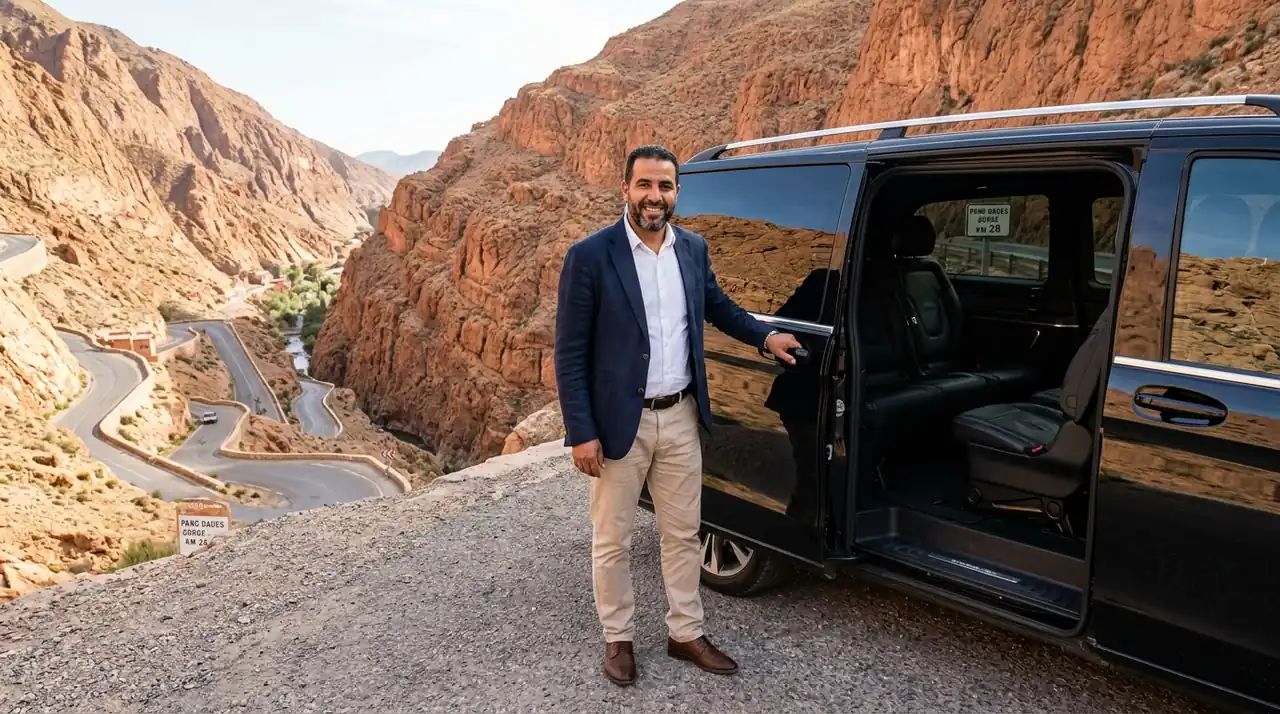
When designing a trip across Morocco’s grand geographic circuits, one pivotal decision dictates your daily stress level, safety, and cultural immersion: should you book a private tour with a professional chauffeur, or should you rent a car and self-drive? While self-driving through Western Europe or North America is often straightforward, Morocco presents an entirely different road ecosystem characterized by high-altitude mountain passes, intense medina traffic, unmarked rural hazards, and ubiquitous police radar checkpoints.
Quick Answer: Private Tour vs Self-Drive
Self-driving is feasible if: You are an experienced, assertive international driver sticking strictly to the modern coastal toll motorways (Autoroutes) connecting Casablanca, Rabat, and Tangier, or if you are traveling on an ultra-tight shoestring backpacker budget where public buses are your alternative.
A private tour with dedicated chauffeur is vastly superior if: Your itinerary includes crossing the High Atlas Mountains (Tizi n’Tichka), exploring the Dades and Todra gorges, or traveling to the Sahara desert dunes of Merzouga. A professional driver completely removes the stress of mountain switchbacks, language barriers at police checkpoints, parking logistics outside car-free medinas, and vehicle liability.
- Safety & Peace of Mind: Your local driver understands unpredictable rural traffic patterns (mules, mopeds without headlights, livestock) and handles mechanical emergencies effortlessly.
- True Cost Reality: Once you factor in mandatory full insurance, fuel, toll booths, parking fees, and international rental security deposits (€1,500 to €2,500 held on your credit card), a private vehicle often costs only slightly more per person while delivering infinitely higher value.
The Reality of Driving in Morocco: Highways vs. Mountain Roads
To evaluate whether self-driving is right for you, it is vital to distinguish between Morocco’s two distinct road networks: the modern toll autoroutes and the winding national routes through the mountains.
The Toll Motorways (Autoroutes du Maroc – ADM)
Morocco boasts one of the most advanced motorway networks in Africa. The multi-lane toll highways connecting Tangier, Rabat, Casablanca, Marrakech, and Agadir are impeccably paved, clearly signed in both Arabic and French, and equipped with modern service stations offering clean restrooms and espresso bars. If your entire Moroccan journey consists of traveling from Casablanca airport to Rabat and Marrakech, driving is relatively simple.
The National Routes & Mountain Passes (The Real Morocco)
The moment you leave the tollway system to venture toward the Sahara Desert, the imperial cities of Fez and Chefchaouen, or the southern oasis valleys, road conditions change dramatically. The N9 highway crossing the High Atlas Mountains ascends to 2,260 meters over the Tizi n’Tichka pass. While recently widened, this road features dizzying mountain precipices, tight hairpins, and sudden construction bypasses where heavy transport trucks crawl at 20 km/h.
Furthermore, rural Moroccan roads are shared spaces. At any given turn, you will encounter stray sheep, untethered donkeys carrying firewood, children walking home from school along narrow shoulders, and vintage Mercedes “grand taxis” overtaking blind on two-lane mountain curves. When you hire a private chauffeur through our private car with driver service, you have a veteran driver whose daily livelihood is mastering these specific mountain roads, allowing you to relax, take photos, and soak in the majestic landscapes.
Navigating Police Checkpoints: What Self-Drivers Never Expect
One of the most intimidating surprises for tourists renting a car in Morocco is the sheer density of police and Royal Gendarmerie checkpoints. Across major regional boundaries and outside virtually every town—such as Ouarzazate, Tinghir, and Erfoud—you will encounter fixed checkpoints marked with prominent white road signs reading “Halte Police” or “Gendarmerie Royale”.
The Checkpoint Protocol
At these stations, you cannot simply slow down and roll through; you must come to a complete, absolute dead stop several meters before the stop line and wait patiently until the officer formally signals you forward with a wave of the hand. Creeping past the stop sign without an explicit hand signal is an immediate traffic infraction carrying a mandatory on-the-spot cash fine of 400 Moroccan Dirham (~$40 USD).
Language Barriers & Speed Traps
Speed limits drop abruptly from 100 km/h down to 80 km/h and then strictly 60 km/h several hundred meters before town boundaries, where officers equipped with laser radar guns monitor approaching vehicles. If you do not speak fluent French or Moroccan Darija (Arabic), explaining yourself to traffic police while holding up traffic can be a stressful, disorienting experience. A professional local driver handles all checkpoint interactions with effortless courtesy, greeting officers warmly in Darija and clearing checkpoints in seconds without awkward delays.
| Evaluation Criteria | Self-Drive Rental Car | Private Chauffeur Tour |
|---|---|---|
| Driver Fatigue & Stress | High (Intense concentration required for 6–10h daily) | Zero (Sit back, relax, enjoy Wi-Fi, nap, or take photos) |
| Mountain Road Safety | Challenging; hairpins, sheer drops, blind overtaking | Expert mountain driver with hundreds of pass crossings |
| Medina Parking & Navigation | Complex; riads are car-free; parking guardian fees apply | Driver coordinates door-to-door luggage porterage to riad |
| Police Checkpoint Interactions | Frequent; language barriers; risk of on-the-spot fines | Handled in seconds seamlessly in local Darija language |
| Flexibility on Route | High; you choose stops but must find parking & road paths | Highest; stop anytime for photos, tea, or artisan workshops |
| Cultural Insights & Insider Access | None; reliant on guidebook apps and Google reviews | Rich daily stories, Berber history, genuine local recommendations |
| Hidden Cost Surprises | Rental deposits (€2,000+), fuel, tolls, parking, scratch disputes | Transparent all-inclusive pricing with vehicle, fuel & driver |
| Best Suited For | Experienced overlanders sticking to major tollways | Couples, families, photographers, honeymooners, seniors |
The True Financial Breakdown: Is Self-Driving Really Cheaper?
On rental comparison search engines, renting an economy car in Marrakech often appears tempting at advertised base rates of €25 to €35 per day. However, seasoned travelers know that the base advertised price is rarely the final cost.
The Real Costs of Renting a Car in Morocco:
- Comprehensive Super CDW Insurance: Basic third-party insurance included with rental cars leaves you liable for €1,500 to €2,500 in excess damages. Adding full zero-deductible cover directly at the counter adds €15 to €25 per day.
- Huge Credit Card Security Deposits: Rental agencies hold a pre-authorization hold of €1,500 to €3,000 on your credit card. Any minor rim scratch, sandblasted windshield chip from desert winds, or undercarriage scrape from rocky hotel driveways can result in disputed deductions.
- Fuel Consumption: Fuel prices in Morocco hover around 14 to 15 MAD per liter ($1.40–$1.50/L). A typical 1,200 km round trip to Merzouga consumes roughly $180 to $220 in gasoline or diesel.
- Parking Fees: Because historic medinas in Marrakech, Fez, and Chefchaouen are strictly pedestrianized, you must park your vehicle in guarded open-air parking lots (parkings gardés) overnight, paying 30 to 50 MAD per night, plus tipping daytime parking attendants.
- Traffic Fines: Getting caught once or twice by radar checkpoints can easily add $80 to $120 in unexpected cash penalties.
The Private Tour Value Equation
When you book an all-inclusive custom private Morocco tour, the price covers the premium vehicle (such as a 4×4 Toyota Prado or luxury Mercedes V-Class minivan), all commercial passenger insurance, unlimited fuel, highway tolls, parking fees, and the driver’s daily accommodations and meals. When split among a couple or a family of four, the cost difference per person is remarkably modest—while completely eliminating thousands of euros in financial liability holds on your credit card.
The Medina Dilemma: Parking and Luggage Logistics
The most charming accommodations in Morocco are historic riads—traditional courtyard mansions located deep within the ancient walled medinas of Marrakech, Fez, Chefchaouen, and Essaouira. These medinas were built centuries before automobiles; their streets are narrow pedestrian labyrinths where cars physically cannot enter.
When you self-drive, you must navigate chaotic city ring roads, find a legitimate guarded parking lot outside the city gates, negotiate parking rates with local attendants, and then drag heavy wheeled luggage through crowded cobblestone alleyways trying to decipher offline maps. If you take a wrong turn, unofficial street touts often harass you, demanding money to guide you to your riad.
With a private driver, the experience is effortless. Your chauffeur drives directly to the nearest designated drop-off gate, calls your riad manager in advance, and arranges for an official riad porter with a luggage handcart to meet you at the vehicle. You walk into your riad without touching your luggage, greeted by fresh mint tea and almond pastries while your driver securely parks the vehicle outside.
Emergency Roadside Assistance & Rural Breakdowns: Who Do You Call?
Mechanical emergencies in rural Morocco can quickly derail an unassisted road trip. Punctured tires from sharp desert gravel, overheated radiators ascending high mountain passes, and dead batteries in remote valleys present daunting logistical hurdles if you are self-driving.
Most international rental agencies do not maintain operational branch offices south of the Atlas Mountains. If your rental vehicle breaks down between Boumalne Dades and Tinghir, waiting for a replacement vehicle from Marrakech can leave you stranded on the roadside for 8 to 12 hours. Moreover, English-speaking roadside assistance hotlines are virtually non-existent in remote provinces.
In contrast, private tour operators maintain a nationwide support network. Professional chauffeurs carry heavy-duty tire inflation compressors, hydraulic jacks, and full-sized spare wheels. If a mechanical issue occurs, your driver diagnoses and handles it immediately. In the rare event of a major engine breakdown, tour agencies dispatch a replacement licensed touring vehicle from regional transport hubs like Ouarzazate or Errachidia within two hours, ensuring your scheduled hotel reservations and desert camel treks proceed without interruption.
Fueling Etiquette & Cash Realities in the Desert Provinces
Another operational reality of self-driving across southern Morocco is the management of fuel stations and payment methods. In modern cities like Casablanca, Rabat, and Marrakech, Shell, Total, and Afriquia gas stations reliably accept foreign Visa and Mastercard credit cards.
However, once you cross the High Atlas Mountains into the pre-Saharan desert plateaus, many remote fuel stations operate on a strictly cash-only basis. Credit card terminal satellite connections frequently fail due to regional telecom outages. Furthermore, distances between reputable fuel stations can exceed 90 to 120 kilometers along desert corridors like the Alnif-to-Rissani highway.
Self-drivers who forget to top up their tanks before remote stretches risk running on empty in isolated areas where no emergency roadside services exist. A professional chauffeur continuously monitors fuel levels, knows precisely which reputable stations offer high-grade filtered diesel, and handles all transactions seamlessly, removing all fuel anxiety from your vacation.
Cultural Insights and Insider Access: The Human Connection
Beyond road safety and logistics, the greatest intangible advantage of a private chauffeur is having a trusted local companion throughout your journey. Our chauffeurs are born and raised in Morocco—many hailing from Berber families in the High Atlas or the Sahara Desert.
Instead of relying on outdated travel forums, your driver introduces you to authentic roadside culinary gems that tourists rarely find: roadside butchers grilling fresh lamb chops over olive wood coals, mountain cooperatives making pure culinary argan oil, and hidden panoramic viewpoints far from crowded tour bus pull-offs. They explain Berber customs, teach you useful Darija greetings, protect you from aggressive medina vendors, and help you navigate cultural nuances with ease. Many of our travelers write in reviews that their private driver became the highlight of their Moroccan vacation.
Frequently Asked Questions: Private Tour vs Self-Drive
Do I need an International Driving Permit (IDP) to rent a car in Morocco?
Legally, a valid driver’s license from your home country (in English or European languages) is generally accepted by major international rental companies at airports. However, having an International Driving Permit alongside your domestic license is strongly recommended to avoid potential confusion during regional police checkpoint inspections.
Are the roads safe for driving at night in Morocco?
Driving at night in rural Morocco is strongly discouraged for self-drivers. Many secondary roads lack street lighting, pedestrians and cyclists often travel without reflectors, and broken-down vehicles frequently lack warning triangles. Professional tour chauffeurs plan all travel legs to arrive comfortably before sunset.
Can our private driver also act as our historical tour guide inside monuments?
In Morocco, national tourism law strictly separates licensed chauffeurs from official city guides. Your private driver handles all inter-city transport, scenic stops, and cultural context. For deep historical walking tours inside closed UNESCO monuments (such as the Saadian Tombs in Marrakech or Al Quaraouiyine Mosque in Fez), we arrange certified local municipal guides.
Can we customize our stops and daily departure times on a private tour?
Absolutely. Unlike rigid group bus tours, a private tour moves entirely at your personal rhythm. If you wish to sleep in an extra hour, spend an extra 45 minutes photographing the Todra Gorge, or pause at an artisan pottery workshop, your driver accommodates your preferences completely.
What vehicle types are used for private tours?
For couples and solo travelers, we utilize modern high-clearance 4×4 vehicles (such as Toyota Prado TX). For families and small groups, we deploy luxury Mercedes-Benz V-Class minivans with leather seating, climate control, and expansive panoramic windows.
The Final Verdict: Making the Right Choice for Your Morocco Journey
- Choose Self-Drive if: You are traveling strictly along the Atlantic coast between Casablanca and Tangier on multi-lane tollways, have extensive international driving experience, and love the challenge of navigating foreign road systems on your own.
- Choose a Private Chauffeur Tour if: Your dream is to visit the Sahara Desert, the High Atlas Mountains, and the Imperial Cities with total safety, comfort, cultural immersion, and zero logistical stress. Explore our signature private desert tours to discover why private travel is the gold standard for exploring Morocco.
Experience Morocco with a Dedicated Professional Driver
Relax in premium comfort with an experienced, English-speaking Moroccan driver. Discover hidden gems, avoid tourist traps, and travel at your own pace.