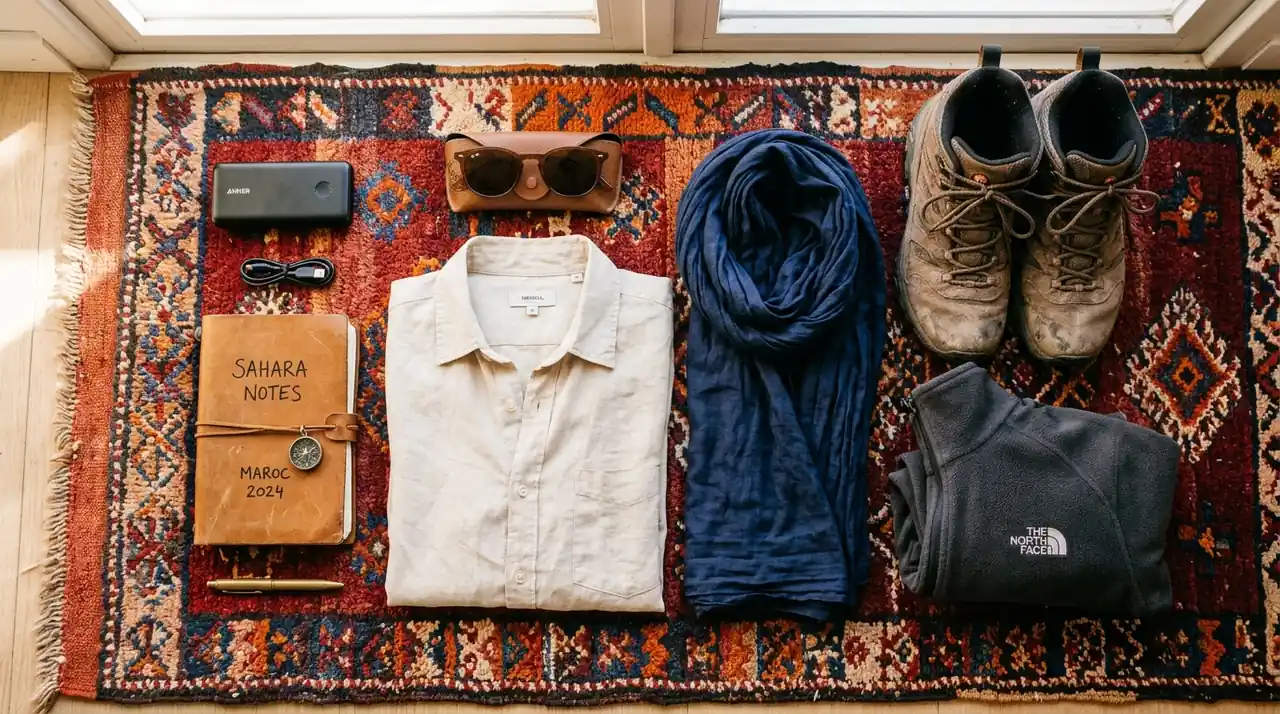
Packing for a Moroccan desert tour is one of the most deceptively complex challenges in international travel. In a single 24-hour cycle on the road to Merzouga or Erg Chigaga, you will transition from sunny Mediterranean plains in Marrakech (25°C) to chilly sub-alpine mountain passes at 2,260 meters elevation (10°C), before descending into the bone-dry arid heat of the Sahara Desert—where nighttime temperatures frequently plummet toward freezing (3°C). Packing inappropriately leads to freezing in unheated bivouacs, ruined camera lenses from airborne quartz dust, or agonizing blistered feet on camel saddles.
Quick Answer: The Non-Negotiable Sahara Essentials
The Golden Rule: Dress in breathable natural layers (merino wool, linen, lightweight cotton) rather than heavy single garments. The desert shifts through a 20°C to 25°C temperature swing between day and night.
- Must-Have #1: A traditional 2- to 3-meter cotton Cheche (Berber turban scarf) to seal your face and ears from blowing silica sand.
- Must-Have #2: Two luggage bags: leave your large rolling suitcase securely locked in your private tour vehicle; bring only a compact 20L to 30L daypack on your camel to the desert tent.
- Must-Have #3: High-capacity power bank (10,000–20,000 mAh), polarized UV400 sunglasses, closed-toe trail sneakers, and thermal sleepwear (even in summer, desert nights feel brisk).
The Climate Reality: Understanding the 25°C Diurnal Temperature Swing
To pack effectively, you must understand the desert’s thermal dynamics. Dry silica sand has an exceptionally low specific heat capacity and virtually zero moisture content in the atmosphere to trap radiant heat. While direct sunshine heats the sand surface up to 40°C (104°F) in spring and autumn, the moment the sun dips beneath the horizon, heat radiates into the clear troposphere almost instantly.
Between November and February, daytime temperatures in Erg Chebbi are pleasant and sunny around 18°C to 22°C, but night temperatures regularly drop to 2°C to 5°C (35°F to 41°F). Between April and October, days are hot (30°C to 38°C), yet nights cool down rapidly to 16°C to 20°C with noticeable desert winds. Packing exclusively for “hot weather” is the number one mistake first-time visitors make on our 3-day Marrakech to Merzouga desert tours.
Clothing Strategy: The Layering System by Time of Day
1. Daytime Transit & Mountain Crossing (08:00 AM – 04:00 PM)
Your days will involve comfortable riding in an air-conditioned 4×4 or minivan, interspersed with walking tours through historic earthen ksars like Ait-Ben-Haddou and along rocky paths in the Todra Gorge. Pack clothing that is comfortable for long seated stretches yet respectful of local rural traditions:
- Breathable Long-Sleeve Tops: Lightweight linen or moisture-wicking synthetic shirts with UPF 50+ sun protection. Long sleeves protect your arms from intense high-altitude mountain sun and hot vehicle window glass.
- Loose-Fitting Cotton or Hiking Pants: Avoid tight jeans that chafe after four hours in a vehicle. Lightweight travel chinos, cargo trousers, or linen joggers are ideal. Avoid short-shorts or revealing tank tops when visiting conservative Berber villages.
- Mid-Weight Fleece or Denim Jacket: Keep a fleece handy inside the vehicle cabin; when stopping at the Tizi n’Tichka mountain summit (elevation 2,260 m), chilly alpine winds require an immediate warm layer.
2. The Sunset Camel Trek (05:00 PM – 06:30 PM)
Riding a dromedary (camel) is an unforgettable adventure, but camel saddles are coarse wooden pack frames padded with thick woolen blankets. What you wear determines your comfort during the 45- to 60-minute trek:
- Long Pants Are Essential: Never attempt to ride a camel in shorts, skirts, or dresses. The rough saddle blankets and the camel’s coarse hair will chafe bare inner thighs and knees within fifteen minutes.
- Seamless or Stretch Undergarments: Choose soft athletic underwear without thick seams to prevent saddle friction.
- Closed-Toe Shoes: When mounting and dismounting camels, you step into loose, fine sand. Flip-flops and sandals will slip off or fill with sand immediately.
3. Campfire Evening & Stargazing (07:30 PM – 11:00 PM)
Once you arrive at your desert camp, the temperature drops rapidly. You will dine inside a traditional caidal tent and sit around an open-air wood campfire listening to live Gnawa drumming under the stars:
- Thermal Base Layer: A top and bottom set of lightweight merino wool thermal underwear is a lifesaver between November and March.
- Down or Synthetic Puffer Jacket: An ultra-light packable down jacket (such as Uniqlo or Patagonia) weighs under 300 grams, packs down to the size of a water bottle, and keeps you cozy while stargazing.
- Warm Beanie & Wool Socks: Your head and feet lose heat rapidly when standing on cooling sand after dark. A warm knit beanie and thick wool socks guarantee evening comfort.
| Seasonal Period | Expected Daytime Temp | Expected Night Temp | Critical Packing Priority |
|---|---|---|---|
| Winter (Dec – Feb) | 16°C – 20°C (Sunny, crisp) | 2°C – 6°C (Near freezing) | Thermal long johns, packable down coat, wool beanie & gloves |
| Spring (Mar – May) | 24°C – 30°C (Warm, breezy) | 12°C – 18°C (Pleasant) | Linen shirts, cotton cheche scarf, medium fleece layer |
| Summer (Jun – Aug) | 38°C – 44°C (Intense heat) | 22°C – 28°C (Warm) | Electrolyte powders, UV sun protection, ultra-light loose clothing |
| Autumn (Sep – Nov) | 26°C – 32°C (Ideal climate) | 14°C – 19°C (Comfortable) | Versatile layering, trail running shoes, windbreaker jacket |
Footwear Guide: The Two-Shoe Rule
You do not need heavy mountaineering boots for a standard Sahara desert tour, but bringing only open sandals is a recipe for discomfort. We recommend following our strict Two-Shoe Rule:
1. Sturdy Trail Runners or Walking Sneakers
A pair of breathable trail running shoes or low-top hiking shoes with good rubber traction is your primary footwear. You will need them for scrambling over the loose clay steps at Ksar Ait-Ben-Haddou, walking across the wet gravel riverbed in the Todra Gorge, and climbing the steep ridgelines of the Erg Chebbi dunes. Choose shoes that shake out easily when sand inevitably enters.
2. Slip-On Camp Sandals or Flip-Flops
Once you arrive at your desert camp, kick off your sneakers outside your tent and slip into comfortable sandals or slide slippers. They are perfect for walking across the flat carpeted boardwalks of your luxury camp, visiting the dining lounge, and letting your feet breathe after a long travel day.
The Berber Cheche (Turban Scarf): Function Over Fashion
Every photograph of the Sahara features travelers in colorful cotton scarves wrapped securely around their heads. Many tourists assume this is merely a tourist photo gimmick, but in reality, the Cheche (or tagelmust) is the most technologically sophisticated piece of survival gear developed by Saharan nomads over thousands of years.
Unlike baseball caps or fedoras that blow away in desert gusts, a 2.5- to 3-meter cotton scarf wrapped around the crown, ears, and neck provides 360-degree ultraviolet protection. More importantly, when an afternoon breeze kicks up fine quartz sand, you can pull the lower fold over your mouth and nose, allowing you to breathe freely without inhaling silica dust. You can purchase an authentic cotton cheche from artisan cooperatives in Tinghir or Rissani for 60 to 100 MAD ($6 to $10 USD), and your driver will gladly teach you the traditional Berber wrapping knot.
Electronics & Camera Gear: Shielding from Sahara Sand
Sahara sand is not coarse beach sand; it is micro-fine powdered silica that finds its way into every zipper, dial, and optical zoom barrel. Protecting your electronic equipment requires deliberate preparation:
- High-Capacity Power Bank (10,000 to 20,000 mAh): While our recommended luxury glamping camps feature 24/7 solar power sockets, overnight cold desert temperatures reduce lithium-ion battery efficiency by up to 30%. Having a portable power bank in your daypack guarantees your smartphone will not shut down right as the sunrise crests the dunes.
- Ziploc Freezer Bags for Cameras & Phones: Heavy-duty sealed zip bags are the simplest, most effective defense against airborne sand. When not actively taking photos, keep your phone and mirrorless camera sealed inside a Ziploc bag inside your daypack.
- Avoid Changing Camera Lenses on the Dunes: If you shoot with an interchangeable lens camera, choose a versatile zoom lens (like a 24-70mm or 24-105mm) and keep it mounted. Changing lenses on open sand dunes guarantees micro-dust will settle onto your camera sensor.
- Universal European Plug Adapter (Type C/E): Morocco utilizes standard continental European 220V dual-round-pin sockets. Make sure your chargers match.
Toiletries, Skincare & Health Essentials
The Sahara atmosphere has relative humidity levels below 12%, causing skin, lips, and sinuses to dry out rapidly:
- Broad-Spectrum Mineral Sunscreen (SPF 50+): Sand reflects up to 25% of solar ultraviolet radiation. Apply sunscreen generously to your face, back of the neck, and tops of your ears before mounting your camel.
- Intensive Lip Balm with Beeswax: Ordinary lip gloss evaporates in minutes; bring a heavy beeswax or petroleum-based lip balm with SPF to prevent painful cracked lips.
- Saline Nasal Mist & Eye Drops: Dry desert air combined with vehicle air-conditioning causes dry nasal passages and irritated eyes, especially for contact lens wearers. Lubricating eye drops offer instant relief.
- Biodegradable Wet Wipes: Invaluable for wiping away trail dust, refreshing hands before meals, and cleaning camera bodies.
- Personal First-Aid Essentials: Pack travel-sized ibuprofen, Imodium or Pepto-Bismol for dietary adjustment, electrolyte rehydration powder packets, motion sickness tablets for mountain switchbacks, and blister band-aids.
Luggage Logistics: The Two-Bag Strategy for Camel Treks
One of the most frequent logistical anxieties travelers have is: “How do I fit my giant 25-kilogram rolling suitcase onto a camel?” The answer is simple: you don’t.
Dromedary pack saddles cannot accommodate hard-shell rolling suitcases. When you arrive in Merzouga, your private chauffeur parks your vehicle in a secure, guarded garage at our partner desert hotel. Your main heavy luggage remains safely locked inside the vehicle.
You only take a compact 20- to 30-liter daypack containing your overnight sleepwear, change of clothes, camera, power bank, toiletries, and valuables on the camel trek into the desert camp. The next morning, when you return from the dunes, you reunite with your primary luggage before driving onward. If you are physically unable to ride a camel or have mobility limitations, our luxury camp 4×4 luggage shuttle transports you and your bags directly to your tent door.
Frequently Asked Questions: Desert Packing Checklist
Should I wear contact lenses or glasses in the desert?
We strongly recommend wearing prescription eyeglasses or sunglasses rather than contact lenses in the dunes. Airborne micro-sand particles can easily get trapped behind contact lenses, causing cornea irritation. If you must wear contacts, bring daily disposables and protective wrap-around sunglasses.
Do I need to bring my own sleeping bag or bed sheets?
No. Both standard and luxury desert camps provide complete bedding including mattresses, sheets, and heavy woolen blankets. On our luxury private tours, camps feature hotel-grade spring mattresses, hypoallergenic duvets, and fresh laundered Egyptian cotton linens.
Is there cellular mobile signal and Wi-Fi in the desert?
At Erg Chebbi (Merzouga), Maroc Telecom and Orange 4G mobile coverage is surprisingly strong along the dunes. Most luxury desert camps provide complimentary satellite Wi-Fi in their central dining and lounge tents. At Erg Chigaga, cellular signal is extremely weak or absent, offering true digital detox.
Can I bring a drone to film the Sahara sand dunes?
No. Drones are strictly illegal in Morocco without prior commercial aviation permits from the Moroccan Civil Aviation Authority. Attempting to bring an undeclared drone through airport customs will result in confiscation, heavy fines, and lengthy police questioning at port of entry.
Can I drink tap water at the desert camps?
No. You should always drink bottled mineral water throughout Morocco. On all our private tours, complimentary chilled bottled water is provided in the vehicle and at the desert camps throughout your itinerary.
Conclusion: Ready for an Unforgettable Sahara Adventure
By packing smart with breathable layers, proper foot protection, a protective cotton cheche, and a compact overnight daypack, you ensure your Sahara expedition is defined by awe-inspiring desert sunsets rather than preventable discomfort. Check out our signature Top Morocco Desert Tours for 2026 to begin planning your personalized private Sahara journey.
Let Us Handle the Desert Logistics For You
From luxury climate-controlled 4×4 transport to private en-suite desert suites under the Sahara stars, our bespoke private tours make exploring Morocco effortless.