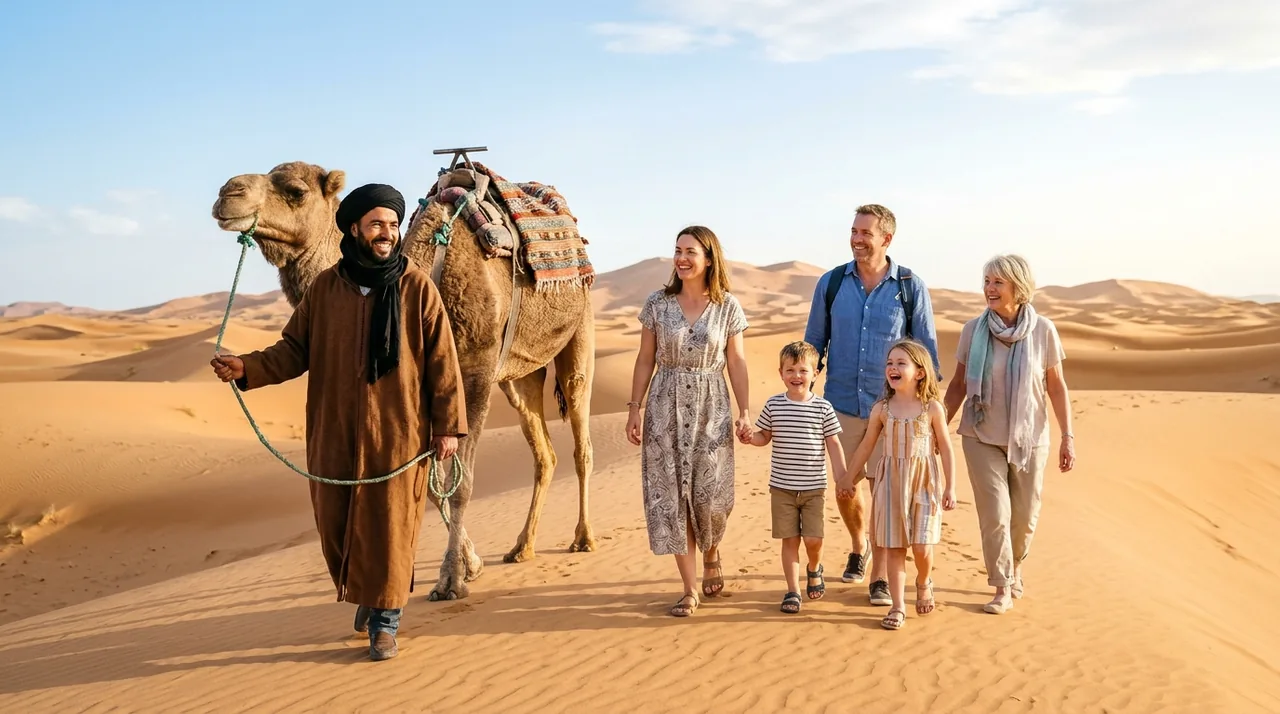
Few travel experiences captivate a child’s imagination quite like Morocco. Riding a gentle dromedary camel across towering golden dunes, exploring real mudbrick desert fortresses straight out of Arabian fairy tales, stargazing at the Milky Way from a cozy luxury tent, and watching street acrobats in ancient lantern-lit squares create indelible childhood memories. Yet, planning an international family holiday across the Sahara requires thoughtful pacing, realistic road timing, reliable sanitation, and insider safety wisdom.
Quick Answer: Is Morocco Family-Friendly & What Is the Ideal Desert Setup?
Yes, Morocco is exceptionally child-friendly. Moroccan culture deeply treasures children (*atfal*), and families traveling with little ones are welcomed with open arms, priority queues, and heartfelt warmth across riads, restaurants, and souks.
The Golden Rules for Desert Travel with Kids:
- Choose Erg Chebbi (Merzouga) Over Erg Chigaga: Erg Chebbi is reached via smooth paved asphalt highway (N9 to N10 to N13) with modern pharmacy access and luxury air-conditioned camps. Avoid Erg Chigaga for young kids due to the punishing 2 to 3-hour off-road sand track which frequently triggers severe car sickness.
- Mandatory 4-Day Minimum Pacing: Never book a 3-day express tour with children. The 9-hour driving days will exhaust them. A 4-Day or 5-Day private circuit with swimming pool stops in Skoura or Dades Valley makes the journey relaxing and joy-filled.
- Book a Private Chauffeur: A private Mercedes minivan gives your family complete autonomy to take bathroom breaks, nap on schedule, pause for scenic photos, and travel at your child’s natural pace.
- Recommended Minimum Age: 4 to 5 years old is the ideal starting age for a desert camel trek, though younger toddlers easily thrive if opting for 4WD transport directly to the desert camp.
Why Moroccan Culture Welcomes Families with Warmth
In many Western travel destinations, dining in boutique hotels or navigating historical monuments with young children can feel stressful. In Morocco, the experience is completely reversed. Family is the sacred cornerstone of Moroccan social life. From the moment you land at Marrakech Menara Airport, hotel managers, restaurant waiters, and desert drivers will beam with delight at your children, greeting them warmly, offering complimentary freshly baked breads and fruit juices, and going out of their way to ensure their comfort.
In Moroccan riads, staff members frequently treat young guests like visiting royalty, offering them hands-on cooking demonstrations (such as shaping semolina *khobz* dough) or organizing gentle treasure hunts around the courtyard fountains. Rather than viewing children as an inconvenience, Moroccan hospitality treats them as honorary ambassadors of joy.
Age-by-Age Breakdown: What Works Best in Morocco
Every developmental stage has unique travel requirements across North Africa:
Toddlers & Preschoolers (Ages 1 to 4)
Traveling with toddlers in Morocco is entirely doable with realistic expectations. The primary challenges are nap schedules, sensory overload in dense souks, and car-seat logistics. Strollers are virtually useless in ancient medinas due to cobblestones, steep stairs, and packed crowds; a sturdy ergonomic baby carrier (such as an Ergobaby or Deuter hiking pack) is essential. For the desert trek, toddlers should never ride a camel alone; they must ride securely strapped to an adult in a front baby carrier, or the family can simply ride in the air-conditioned 4WD support vehicle directly to the camp tent in 10 minutes while older siblings ride camels.
School-Age Children (Ages 5 to 11)
This is the golden age for Moroccan exploration. Children in this bracket possess boundless curiosity and the stamina to enjoy 1-hour camel treks, hunt for 350-million-year-old marine fossils in Erfoud, learn to bake Berber flatbread over hot stones, explore the cavernous movie sets of Atlas Film Studios in Ouarzazate, and race down sand dunes on wooden sandboards. Keep driving days punctuated with frequent leg-stretching breaks, and choose boutique kasbahs with swimming pools where they can burn off energy before dinner.
Tweens & Teens (Ages 12 to 17)
Teenagers fall head-over-heels in love with Morocco’s adventure pedigree. For this demographic, quad biking (ATV) across the open desert *reg* plains, climbing Erg Chebbi’s 150-meter-high dunes for sunrise photography, practicing haggling in the artisan souks, and hiking through Todra Gorge’s 300-meter vertical limestone canyon provide unforgettable real-world thrills that pull them away from their smartphone screens.
Choosing the Right Desert Sea: Erg Chebbi vs. Erg Chigaga for Families
One of the most consequential decisions when planning a family desert adventure is selecting the dune destination:
| Travel Factor | Erg Chebbi (Merzouga) — Recommended for Kids | Erg Chigaga (M’Hamid) — Better for Older Teens |
|---|---|---|
| Road Surface Access | 100% smooth paved asphalt up to the dune perimeter | Requires 2 to 3 hours of rugged, jarring off-road track |
| Motion Sickness Risk | Low (steady highway driving with gradual curves) | High (unpaved washboard corrugations and heavy swaying) |
| Emergency Medical Proximity | Clinics in Merzouga (10 min) & full hospital in Erfoud (45 min) | Remote; nearest clinic in Zagora is 3+ hours away |
| Luxury Camp Amenities | En-suite flushing toilets, private showers, heated tents | Rustic to semi-luxury; water pressure can be limited |
| Cellular & Wi-Fi Connection | Strong 4G coverage across most luxury camps | Extremely patchy to zero signal in deep dunes |
| Kid-Friendly Activities | Fossil workshops, sandboarding, swimming pools nearby | Wild wilderness survival feel, long off-road tracking |
For 95% of families, Erg Chebbi is overwhelmingly superior. The peace of mind of having paved highway connectivity, immediate access to medical pharmacies in Erfoud, stable 4G connectivity to check in with family back home, and comfortable luxury camps with guaranteed hot running water makes the experience stress-free for parents.
The 4-Day Minimum Rule: Why Pacing Protects Your Holiday
When searching for desert tours from Marrakech, you will see ubiquitous advertisements for “3-Day Budget Desert Tours”. Avoid these like the plague when traveling with children.
A 3-day circuit forces 18 to 20 hours of driving into just 72 hours. On Day 1, you spend 9 exhausting hours crossing the High Atlas mountains to Dades Valley; on Day 3, you endure a grueling 10-hour straight drive back from Merzouga to Marrakech. For adults, this schedule is punishing; for children, it results in meltdowns, car sickness, skipped meals, and overtired misery.
Instead, book our customized 4-Day or 5-Day private desert itinerary. By adding an extra night along the route—either amidst the lush 1000-palm oasis of Skoura or in the geological wonderland of Dades Valley—daily driving is capped at an easy 3.5 to 5 hours. Your family can sleep in, enjoy leisurely poolside breakfasts, explore ancient kasbahs at a relaxed pace, and arrive at the desert camp refreshed and excited for the sunset camel ride.
Health, Hygiene, Hydration & Motion Sickness Management
Keeping children energetic and healthy requires basic proactive travel medicine:
1. High Atlas Mountain Sickness & Car Sickness
Crossing the famous Tizi n’Tichka mountain pass involves dozens of sweeping switchbacks rising to 2,260 meters. If your children are prone to motion sickness:
- Administer pediatrician-approved pediatric motion sickness medication (such as dimenhydrinate/Dramamine Kids) 30 to 45 minutes before leaving Marrakech.
- Have children wear acupressure motion-sickness wristbands.
- Ensure your private driver keeps fresh air circulating or maintains a comfortable climate-controlled cabin. Our drivers are trained to take gentle curves and pull over whenever a child needs fresh air.
- Avoid letting children read books or stare down at tablet screens during the mountain ascent; encourage them to spot mountaintop Berber villages and grazing goat herds outside the window.
2. Food Safety & Drinking Water
Never give children tap water in Morocco. Always brush teeth and hydrate using sealed bottled mineral water (trusted national brands include Sidi Ali, Ain Atlas, and Ciel). In restaurants, stick to piping-hot, thoroughly cooked dishes like tagines, grilled chicken skewers, and freshly baked breads. Avoid raw salads or unpeeled fruits from casual street vendors; bananas, oranges, and freshly peeled avocados are wonderful safe alternatives.
3. Desert Aridity & Heat Protection
The Sahara atmosphere has virtually zero ambient humidity, causing children to dehydrate rapidly without realizing it because sweat evaporates instantly. Carry electrolyte rehydration packets to mix into bottled water. Dress children in loose, lightweight, long-sleeved linen or cotton shirts that shield sensitive skin from intense UV rays without trapping body heat. High-SPF (50+) sunscreen, UV-blocking sunglasses, and wide-brim sun hats are non-negotiable essentials.
What Picky Eaters Can Eat in Morocco
Parents often worry that their children will reject unfamiliar spices. In reality, Moroccan cuisine is aromatic rather than fiercely spicy hot. Dishes rely on gentle, warming spices like cumin, ginger, cinnamon, and turmeric, keeping hot chili peppers (*harissa*) served strictly on the side in separate dishes.
Kid-Approved Moroccan Staples
- Moroccan Flatbread (*Khobz*): Freshly baked multiple times daily in wood-fired communal ovens, this round, crusty bread is universally devoured by children.
- *Kefta* Meatballs: Minced beef or lamb seasoned with mild cumin and fresh parsley, simmered in a sweet tomato sauce and topped with melted eggs. It tastes remarkably similar to Italian meatballs and is an instant hit with kids.
- Chicken & Lemon Tagine with Fries: Tender, fall-off-the-bone slow-cooked chicken served with mild potatoes. In almost every Moroccan restaurant, tagines can be ordered with a side of crispy French fries (*frites*).
- Honey Crepes (*Msemmen* & *Baghrir*): Flaky square pancakes and spongy “thousand-hole” crepes served warm at riad breakfasts, slathered with pure mountain honey, butter, or Nutella.
- Freshly Squeezed Orange Juice: Morocco produces some of the world’s sweetest citrus. Freshly pressed orange juice (*jus d’orange*) is available everywhere for just 10 to 15 MAD per glass.
Comprehensive Packing Checklist for Family Desert Travel
Pack smartly to keep luggage manageable through riad staircases:
- Clothing: 3–4 pairs of lightweight breathable cotton/linen pants (protects legs during camel rides), 4 lightweight t-shirts, 1 fleece jacket or warm hoodie (desert nights drop dramatically, reaching 5–10°C even in autumn and spring), and comfortable closed-toe slip-on sneakers for walking on hot sand dunes.
- Sun & Dust Protection: Polarized sunglasses for each child, wide-brim sun hats with chin straps, and authentic cotton Berber scarves (*cheches*) purchased in Erfoud to wrap around their faces during windy dune walks.
- Medical & Hygiene Kit: Children’s rehydration salts, pediatric ibuprofen/paracetamol, motion-sickness chewables, hydrocortisone cream for insect bites, waterproof adhesive bandages, hand sanitizer, and biodegradable wet wipes (invaluable for sticky hands in the car).
- In-Car Entertainment: Audiobooks, downloaded offline music playlists, travel journals with coloring pencils, and magnetic road games for scenic driving hours between valley towns.
Family Itinerary Comparison: 3-Day vs. 4-Day vs. 5-Day
| Itinerary Duration | Daily Driving Hours | Overnight Stops | Suitability for Children |
|---|---|---|---|
| 3-Day Express Loop | 7 to 10 hours / day | Dades Valley (1 night), Erg Chebbi (1 night) | Not Recommended: Exhausting, high stress, constant rushing |
| 4-Day Balanced Circuit | 4 to 5 hours / day | Dades Gorge (1 night), Erg Chebbi Camp (1 night), Ouarzazate (1 night) | Highly Recommended: Ample pool time, relaxed sightseeing, great balance |
| 5-Day Immersive Journey | 3 to 4 hours / day | Skoura Oasis (1 night), Dades (1 night), Erg Chebbi (2 nights) | Optimal / Deluxe: Zero fatigue, full day in dunes, fossil workshops |
Frequently Asked Questions About Family Travel in Morocco
Is camel riding safe for young children?
Yes, provided simple safety protocols are respected. Camels in Morocco are gentle, domesticated dromedaries led on foot by an experienced Berber handler (*chamelier*). Children aged 5 and older can safely ride their own camel with the handler holding the lead rein. Toddlers (under 5) should ride seated in front of a parent, or the family can opt for a comfortable 4WD vehicle transfer across the dunes directly to the camp tent.
Do Moroccan vehicles have child safety car seats?
In Morocco, child car seats are not legally mandatory for public transport, and standard taxis do not carry them. However, when you reserve a private family tour with Finest Morocco Tours, we provide sanitized, certified European-standard child car seats and booster seats upon advance request at no additional charge.
Can I buy diapers and baby formula in Morocco?
Yes. Major international brands like Pampers (marketed as *Pampers* or *Dodot*) and French baby formula brands (Guigoz, Gallia, Aptamil) are widely sold in pharmacies (*Pharmacie*) and modern supermarkets (Carrefour, Marjane) in Marrakech, Ouarzazate, and Erfoud. However, in small rural Sahara villages, stock is limited, so we recommend purchasing a 4-day supply in Marrakech before heading across the Atlas.
What happens if my child gets sick in the desert?
The town of Merzouga at the edge of Erg Chebbi has local medical clinics and fully stocked pharmacies. For more advanced pediatric care, the provincial capital of Erfoud features a modern municipal hospital located just a 45-minute paved drive along highway N13. Our private chauffeurs are on 24/7 standby at your desert camp to provide immediate vehicle transport if needed.
Is Morocco safe from a security standpoint for international families?
Morocco is widely recognized as one of the safest and most politically stable countries in Africa and the Mediterranean. The kingdom maintains rigorous security apparatus, including dedicated Tourist Police (*Brigade Touristique*) in every major town. Violent crime targeting tourists is exceedingly rare. As with any destination, exercising normal awareness in crowded medinas is sufficient.
Should we bring a stroller to Morocco?
Leave large strollers at home. The historic medinas of Marrakech and Fes feature thousands of narrow stairs, uneven cobblestones, and tight alleys where wheeled strollers become a burdensome obstacle. A comfortable, ergonomic baby or toddler carrier is infinitely more practical.
Are luxury desert camps equipped with electricity for bottle warmers and devices?
Yes. Our partner luxury desert camps in Erg Chebbi operate state-of-the-art solar battery banks and whisper-quiet generators, providing standard 220V electrical wall outlets inside each private tent for charging phones, cameras, tablets, and baby bottle warmers.
Create Unforgettable Family Memories with Finest Morocco Tours
A family adventure through Morocco is an extraordinary educational and cultural gift that enriches children’s worldviews forever. By entrusting your journey to a dedicated private chauffeur and choosing well-paced, kid-tested desert routes, your family can relax and savor every magical moment. Contact our family travel specialists today to customize your bespoke Morocco family holiday.
Plan Your Dream Morocco Family Adventure
Let our local travel designers craft a safe, relaxed, and utterly unforgettable desert journey tailored to your children’s ages.