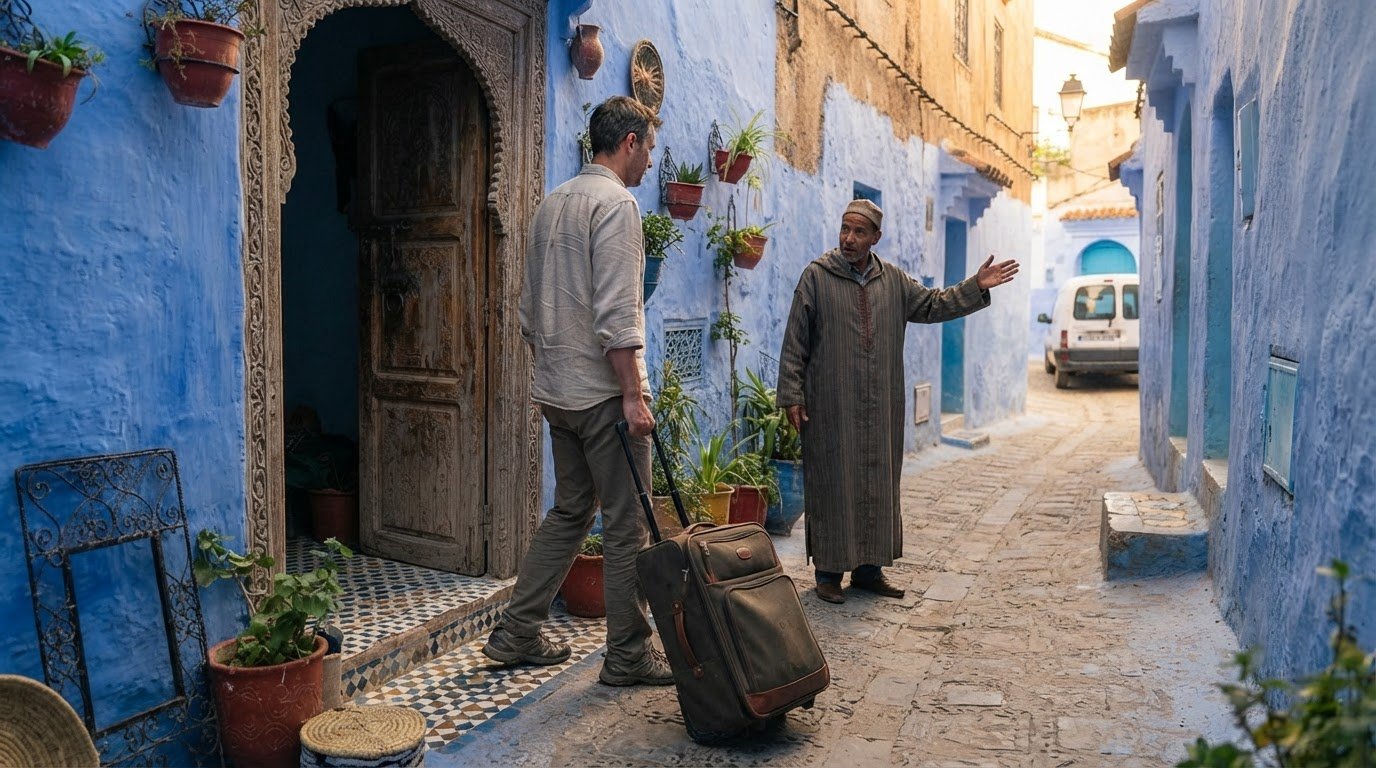
The route matters, but where you stay can shape a Morocco tour without self-driving just as much. Choose accommodation in each destination, then use arranged transport and local guides for journeys and visits. For a desert stay, you can pair a camp with a hotel night.
It’s natural to wonder whether travelling without a car will make your trip complicated. With accommodation, private transport and guided excursions arranged to work together, you can connect medinas, mountain roads and desert landscapes while enjoying the changing scenery.
This guide explains how to choose practical bases, where private transport fits and when a local guide can add context to a visit. You’ll also learn how to bring the pieces together for a comfortable journey at a pace that suits you.
Key Takeaways
- Choose overnight bases that make it easy to explore each destination, then plan transport between them around your route.
- A private driver can simplify longer journeys through changing landscapes, while city-to-city transport can suit other parts of the trip.
- Use local guides for cultural context and hotel-arranged transfers when they make reaching an excursion or desert stay more straightforward.
- Match the itinerary to your travel pace, then consider a driver-led tour or car hire with driver to bring the journey together.
Hiring transport with a driver instead of self-drivingContents
A private driver lets you travel between Moroccan destinations without managing the road yourself. For a Morocco tour without self-driving, you can also combine private transport with trains or coaches on connected routes.
Driver-Only and Driver-Guide Services
Private transport focuses on getting you between places, while a guide adds cultural context to the journey and visits. This distinction can help you decide whether you want commentary along the way or prefer to arrange visits separately. Finest Morocco Tours provides car hire with a driver, as well as tours led by local guides.
Car-Free Tours and Intercity Transfers
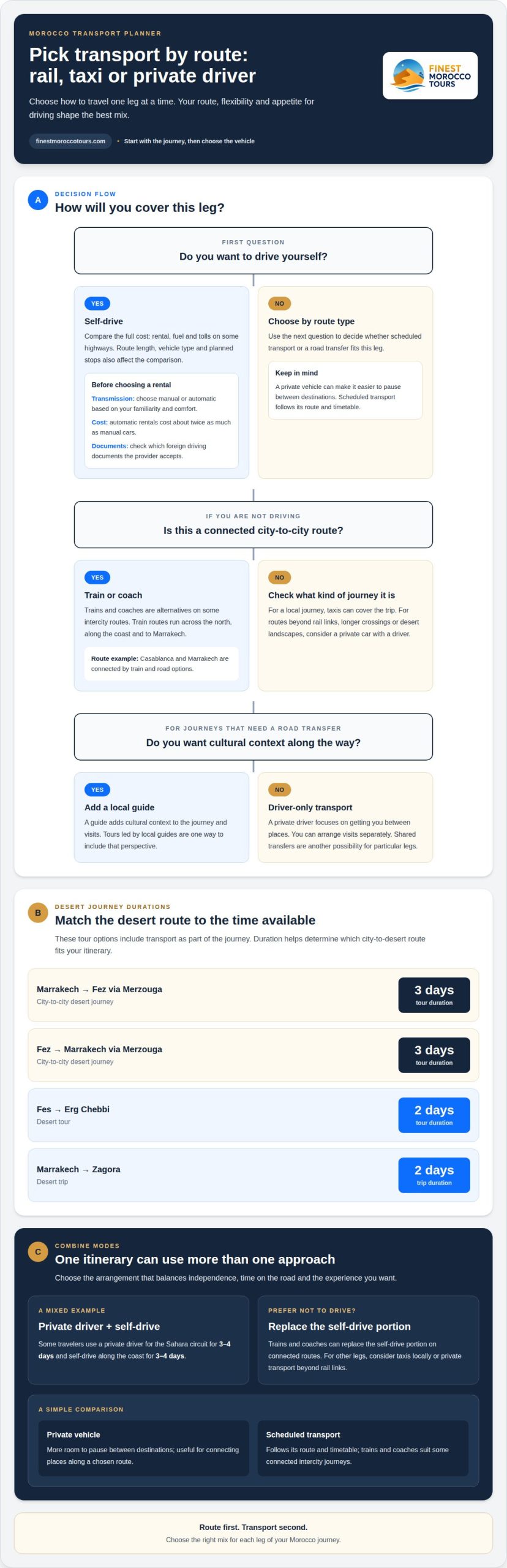
The best ways to tour Morocco without renting a car include hiring a private driver, using trains or coaches on connected city routes, and taking taxis for local journeys. Private drivers can connect Marrakech, Fes, Chefchaouen and the Sahara as part of a planned itinerary; trains and coaches are alternatives on some intercity routes. Shared transfers are a separate possibility to consider for particular legs.
Flexibility depends on the transport chosen. A private vehicle can make it easier to pause between destinations, while scheduled transport follows its route and timetable. Some travelers combine both approaches, using a private driver for the Sahara circuit for 3-4 days and self-driving along the coast for 3-4 days. If you’d rather avoid driving altogether, trains and coaches can replace the self-drive portion.
Compare the full cost structure, not just the vehicle. Self-driving involves rental, fuel and tolls on some highways; a driver-led journey has a different service scope. The route, length of travel and whether guiding is included all shape the comparison. Choose the arrangement that best balances independence, time on the road and the experience you want in Morocco.
Hotels, rental vehicles, transfers, activities and mealsContents
In Morocco, trains, taxis and private cars each suit different parts of a journey. The right mix depends on your destinations, accommodation and planned activities.
Desert Tour Transport and Timing
Desert tours connect transport with the route and time available, making their duration central to choosing an itinerary. Marrakech-to-Fez and Fez-to-Marrakech journeys via Merzouga each take 3 days, while a Fes-to-Erg Chebbi tour takes 2 days. A Marrakech-to-Zagora desert trip also takes 2 days. These tour options include transport as part of the journey, linking the city departure point with desert destinations.
Accommodation and Trip Arrangements
Trip arrangements bring overnight stays, transfers, activities and meals into one travel plan, helping each day connect smoothly. In a desert itinerary, the route and the chosen overnight stay shape how much time remains for activities. Across cities, accommodation near the places you plan to visit can reduce unnecessary transfers. A travel agency can arrange hotels, transfers, a vehicle, activities and meals as parts of a self-drive itinerary.
For city connections, Morocco has train routes across the north, along the coast and to Marrakech; taxis can cover local journeys, while a private car suits routes beyond rail links. Casablanca and Marrakech, for example, are connected by train and road options. If considering a rental, decide between manual and automatic transmission based on your familiarity and comfort. Automatic rentals cost about twice as much as manual cars. Rental terms also set which foreign driving documents the provider accepts, so clarify requirements before settling on a vehicle.
Compare more than the rental charge: self-driving also brings fuel and toll costs, while private transport bundles the journey differently. Route length, vehicle type and planned stops affect the comparison. For a trip connecting Marrakech, Merzouga and Fes, explore desert routes between Marrakech and Fes as one transport-led option.
Trip planning and booking supportContents
A well-paced Morocco itinerary balances travel time with the places tourists hope to experience. A 14-day route can include Casablanca, Tangier, Chefchaouen, Fes, the desert and Marrakech, while an 11-to-14-day trip gives room to adjust the sequence and overnight stays. The right plan depends on whether you prefer a broad circuit or more time in fewer destinations.
Start with the journey’s shape. An Imperial cities tour lasts 8 days and 7 nights, while a mountains-to-desert 4WD tour lasts 6 days and 5 nights. A Great loop by car spans 15 days and 14 nights. These examples show how route ambition and travel style affect the nights available for exploration, rather than suggesting every itinerary should cover the same ground.
Season and arrival plans also influence the order of stops. One planned trip covered about 10 days in September; another travel window ran from September to November for 11-14 days. Use those examples to think through your own timing, then group nearby destinations before adding longer crossings. Essaouira, for instance, can fit a coastal segment from Marrakech, while Chefchaouen and Fes belong naturally in a northern route.
Booking support is most useful when separate elements work as one plan: accommodation, transfers, vehicle arrangements, activities and meals. A riad inside a medina may offer a different arrival experience from a hotel beside a main street, so pickup details should align with the stay. A French-language preference, dietary needs and desired activity pace are practical itinerary details to share early, allowing the arrangements to reflect how you want each day to feel.
Keep the schedule realistic by considering the time between destinations, not only the nights spent there. Casablanca to Marrakech takes approximately 2-3 hours by road, while Marrakech to Essaouira takes about two and a half hours. Building those journeys into the plan helps leave space for arrival, meals and unhurried visits instead of treating every day as sightseeing time.
Using local guides and hotel-arranged transfersContents
Local guides and transfers solve different parts of a Morocco visit. A guide adds cultural context to a walk through a city, while a transfer connects your accommodation with a station, excursion or meeting point. Separating these roles helps you plan what needs explanation and what simply needs transport.
You don’t necessarily need a guide just to enter the medinas of Marrakech or Fes. Walking independently can leave room to notice carved doorways, lively souks and quiet courtyards at your own pace. A local guide becomes especially useful when you want stories behind historic sites, help understanding cultural details, or a structured route through narrow lanes.
For longer excursions, a hotel-arranged transfer can bridge the gap between your lodging and the day’s departure point. This is useful when a tour starts outside the medina, or when you’re returning after an evening activity. In mountain destinations, a prearranged ride can also remove the need to manage a rental car on unfamiliar roads, leaving your attention on the changing landscape.
Desert visits show how local arrangements can extend beyond the hotel door. From Merzouga village, a desert camp can arrange a camel ride or a 4×4 transfer across the dunes. One traveler chose an overnight guided tour to reach a camp rather than renting a car. That format links transport and the desert stay, while keeping the approach to the camp part of the experience.
Give each service a distinct purpose: use a guide for cultural interpretation, walking routes and historic context; use transport for connections between places. For example, explore a medina on foot, then arrange a separate excursion beyond the city. This approach can keep the itinerary relaxed without requiring a driver for every short journey.
For a journey that pairs local insight with transport planning, plan your Morocco tour with local support.
Finest Morocco Tours: Car hire with driverContents
Finest Morocco Tours offers car hire with a driver for travellers who want to explore Morocco without taking the wheel. It’s a practical fit for longer journeys between destinations or desert landscapes, with transport arranged around your chosen route.
For a set itinerary, options include the 3 day desert tour Fez to Marrakech via Merzouga and the 2-Day Chefchaouen, Volubilis and Meknes Tour from Fes. Travelers planning a longer escape can consider the 10-Day Morocco Honeymoon Tour (9 Nights). Each offers a different way to experience the country, from desert scenery to northern heritage.
Planning a trip around private transport or a guided itinerary? Contact Finest Morocco Tours to discuss your route and travel preferences.
Let Your Journey Take ShapeContents
A Morocco tour without self-driving can be shaped around the days you want to remember: a slow morning among medina lanes, a pause in the mountains or an evening beneath desert skies. Before settling on a route, decide what matters most: fewer accommodation changes, time with local guides or the freedom to linger when a place captures your attention. Those preferences can guide the pace and character of your journey.
You don’t need to plan every moment to travel with care. A thoughtful conversation about your destinations, travel style and preferred rhythm can help turn broad ideas into a route that feels personal and manageable. Let the details come together at a pace that suits you, with room for discovery along the way.
Contact Finest Morocco Tours to begin shaping your Morocco journey. May the road ahead bring you closer to the places and moments you’re hoping to find.
Frequently Asked QuestionsContents
Where will I stay?
Choose accommodation in each overnight destination with arrival access and planned visits in mind. A riad inside a medina can put you close to historic lanes, while lodging outside it may make vehicle drop-offs simpler. For a desert overnight, consider how the camp fits the route and what luggage you’ll need for the excursion. Let your itinerary, comfort preferences and transport arrangements guide your choice.
What are the best guided tour itineraries in Morocco for 7, 10, or 14 days?
The best itinerary depends on whether you prefer a focused route or several regions. In 7 days, concentrate on one area and avoid stacking long crossings. With 10 days, you can combine imperial heritage with a desert journey at a measured pace. In 14 days, consider adding a northern stop or coastal time. Leave room for travel between destinations, not only visits.
How can travelers visit Morocco’s Atlas Mountains and coastal towns without a car?
Use a private driver or arranged excursion for mountain routes and coastal journeys, then explore on foot where appropriate. A transfer can connect your accommodation with a walking route, while a local guide adds cultural context. Pairing a guided mountain outing with a separate coastal stay, for example, can be more relaxed than trying to fit both into one rushed day.
Is it safe and reliable to travel around Morocco by train, bus, taxi, and tour?
Transport options serve different needs, and their suitability depends on your route and schedule. Trains and buses connect some intercity destinations; taxis suit local trips, while tours combine transport with planned visits. For a tight connection, allow time between arrival and departure and arrange the next leg in advance. A private itinerary can help when public connections don’t match your route.
How should visitors book Morocco transport and guided tours, and what should they check before paying?
Before paying, review the itinerary, transport arrangements, accommodation, meals, activities and listed exclusions. Confirm departure and return points, tour duration, group format and how changes are communicated. Finest Morocco Tours provides a detailed list of inclusions and exclusions on each tour page. Keep your written booking details together so the arrangements are clear.